“An Orchestra Pit Doubles the Fun” | The Traveling Flutist
- from The New York Flute Club Newsletter
By Dennis Rendleman
For the past eight months, I have had the wonderful opportunity to travel throughout 16 cities in China as the flutist of Broadway International’s The Sound of Music global tour. In addition to flute, I also played piccolo and clarinet for this show.
With musical theater being one of America’s original art forms (alongside jazz), it has been interesting to observe how different cultures and international audiences interact with our performances. For example, the two most common comments that I received from audience members were that they didn’t realize the show utilized live musicians and that they were shocked to see how many different instruments we play in the show.
In the Broadway/musical theater world, the act of playing multiple instruments within a singular performance is often referred to as doubling. The term “doubler” refers to any musician who plays more than one instrument. The history of doubling, in the theatrical sense, dates back to the 1940s, when Broadway woodwind musicians were often expected to play multiple instruments for a production. But what caused this push for multi-wind proficiency? Well to answer this, we must first look at the history of the physical theaters themselves.
Most Broadway theaters are found within old buildings that were built in the late 1800s. Toward the end of the 19th century, the industrial boom in New York City saw a sudden growth in garment production and technological innovation. This rapid growth, combined with the city’s thriving shipping industry, resulted in a drastic inflation in the assessed value of buildings and land in Manhattan.
With the city constantly growing in population and price of construction materials suddenly five times higher than it had been at the beginning of the 19th century, came the birth of railroad apartments. The name of this new building layout resulted not from proximity to an active railroad line, but instead highlighted the narrowness of the floorplan – similar to that of a railroad car. These buildings were often five or six stories high and because of their narrow shape, they could be constructed side-by-side to maximize the number of apartments per block.
This new construction style caught the attention of many businesses and companies, which found that building up (instead of out) was more economical as it required less land. For this reason, Broadway theaters typically feature a design much narrower than most theaters around the world. Additionally, if you’ve ever experienced a production in a historic Broadway theater (such as the New Amsterdam, the Lyceum, or the Hudson), you may have noticed that the seats tend to be smaller and offer little legroom. This is simply because people were generally smaller in the 19th century.
Ok, now that we’ve gone on that historic excursion, the question remains: What caused this push for multi-wind proficiency? With limited stage space inside historic Broadway theaters, designers found there was no space for live musicians. To solve this, the orchestral pit, which originated from 16th century Italian opera houses, was adopted and introduced to Broadway theaters. While this allowed live music to be effectively integrated into musical theater, the fact remained that there simply wasn’t enough space in the pit for a full orchestra. To reduce the number of people in the pit, Broadway musicians would often be expected to play multiple instruments.
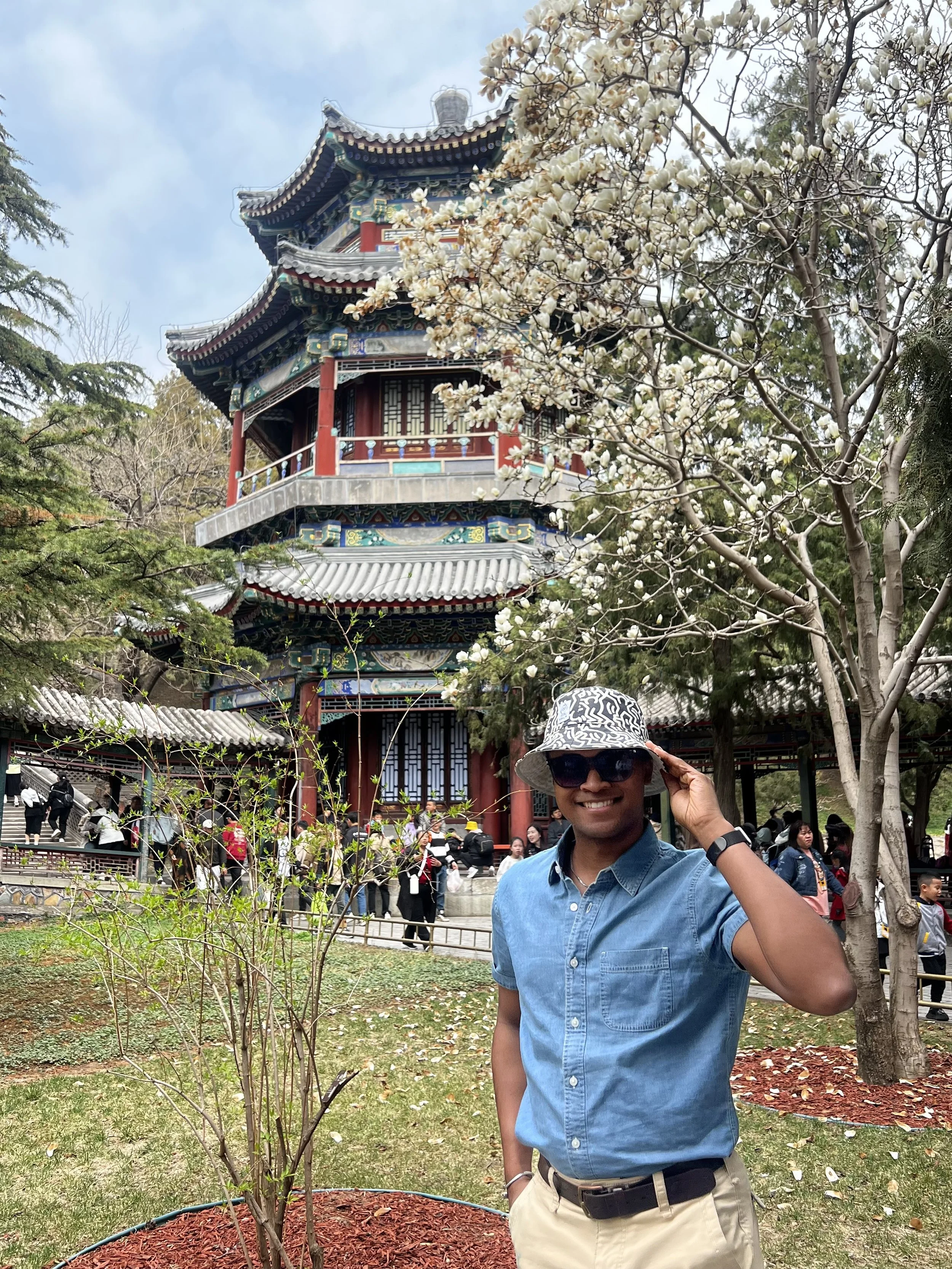
Dennis Rendleman visiting the Summer Palace in Beijing in 2024, while enjoying a day off on The Sound of Music Global Tour.
The standard size for a Broadway pit orchestra used to be between 20 and 30 musicians. Though this is already substantially smaller than a typical symphony orchestra roster, lack of space and budget cuts have continually decreased the size of most Broadway pit orchestras.
Looking at Rodgers and Hammerstein’s The Sound of Music, the original Broadway production included 26 musicians. However today, our tour version requires only 11 musicians. This substantial orchestral reduction was made possible through doubling and electronic keyboards. These keyboards feature what are known as synthesizer (synth for short) patches, which allow the keyboard to sound like various instruments throughout the show to help fill out the orchestral texture.
Ironically, on our tour many of the theaters we performed in were new and feature ample pit orchestra space, however, there were a few venues (e.g., Shanghai Majestic Theatre) that featured layouts more similar to New York City’s. While there are still a few big shows that require larger pit orchestras (e.g., Wicked, The Lion King, Matilda, Les Misérables), the more common challenge for producers is how to shrink the size of the orchestra and still get the musical result they want.
How do you take a full orchestral score and boil it down to 11 musicians? For woodwind material, an arranger will, first, take the full score and decide what is essential (i.e. melodic lines, notes needed to produce full chords, specific tonal colors, etc.). From here they will begin creating individual “reed books” (the term used for multi-instrumental sheet music in musical theater). The arranger will then decide on a primary instrument for each book and the majority of the music within that book will revolve around that specific instrument. This often determines musician selection, as the book will often require someone with a higher proficiency for whichever instrument is the primary focus. Lastly, they will go through all the remaining material and divide it out to the often reed musicians if the primary musician will be busy covering other material.
The main goal of doubling is to ensure the highest percentage of score material is being covered. Anything that is left over is then given to either brass, percussion, or keyboard. Most Broadway shows include up to three reed books. In the most extreme cases, a reed part can requires as many as eight different instruments (Reed III Book for West Side Story covers flute, piccolo, oboe, English horn, clarinet, bass clarinet, tenor saxophone, and baritone saxophone) or even 15 (Reed I Book for The Lion King, which uses 15 different flutes)!
-
Message me with any questions at rendlemandennis@gmail.com or on Instagram (@thetravelingflutist).
Dennis Rendleman sits on the NYFC board and chairs the Social Media Committee.